Tuesday, January 11, 2022

How PCR amplification forms the foundation of DNA-based pathogen testing

The significant importance of the detection of pathogens, I will assume, is perfectly clear to anyone reading this blog. However, I believe it may make sense to discuss some of the general science that permits the declaration of foods as either safe or contaminated.   

Throughout my long, long career in bioanalytical science, I always felt like a detective trying to solve a case. Indeed, we have a lot in common with forensic scientists. We both search for “suspects”; we both need to identify those suspects with 100% confidence; and the price of being wrong could be pretty high in both cases as well. 

However, the major difference is, forensics uses a known crime scene to then hunt for suspects, while we hunt for suspects without knowing if a “crime” has even been committed. Methods used to identify suspects are another area in which we must use slightly different techniques, based on cost, time and confidence level. 

For example, a photo that implicates a suspect seems to offer a high level of confidence of proper identification. Yet, the photo needs to have been taken at a good resolution, the correct angle, etc. Otherwise, proper identification of the suspect cannot happen with 100 percent confidence. Forensics might increase the confidence level of suspect ID by matching fingerprints or DNA at the crime scene. In some ways, we do the same at our “crime scenes”! Yes, microbes don’t leave fingerprints (due to a lack of fingers!), however, microbes do have DNA. So, just like our forensics brethren, we can use a most reliable way to find and identify our suspect.
What is DNA?

Again, most anyone reading this blog post know the basics on what DNA is, but fewer people know the basics on its structure. 

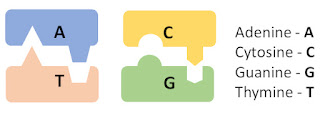
DNA molecules are built of just four nucleobases: Adenine (A), Cytosine (C), Guanine (G), and Thymine (T). These four nucleobases code all genetic information through their sequence in a chain, in similar fashion to the way that computers code all information via sequences of “on” and “off” switches — at a very basic level. But it is made more complicated by the fact that DNA forms not just one but two chains that are connected two each other, forming a double helix.

The double helix is not just two random chains, however, because the chains can bind to one another only where A binds to T and C binds to G. 

DNA as an identification tool

DNA is a convenient object for pathogen detection based on some important properties of this substance. First, with some manipulations, DNA can form millions of copies out of one molecule. Moreover, one does not need copies of the whole molecules. One needs only copies of a part of DNA that codes a unique feature of an organism. For example, to detect Shiga toxin-producing E. coli (STEC), one needs to identify only small parts of DNA unique for coding E. coli itself and for coding a gene responsible for Shiga toxin. The rest of DNA molecule is not really needed.

The ability to create numerous copies of molecule fragments out of one molecule (known as “amplification”) is an extremely powerful tool as well, in that it solves the issue of sensitivity in a great way. Most DNA-based detection methods start with amplification through a method called Polymerase Chain Reaction (PCR).

PCR: how it works

PCR-based amplification employs a basic unit called a thermocycler. The machine can very quickly alternate the temperature of a low-volume reaction medium. A cycle starts by increasing the temperature to 95-98 C. Under these conditions, the two strands of the suspect double helix break apart. The temperature then is quickly lowered, allowing the DNA strands to rebind.

However, primers — short, chemically synthesized portions of DNA molecule that perfectly match the end of the “suspect” DNA fragment of interest — have been added to the solution in great numbers (think, billions of primers), so the chains typically rebind with two primers. Because of the extreme population of primers in the solution, there is a much higher chance the DNA strands will bind to primers rather than its original partner.
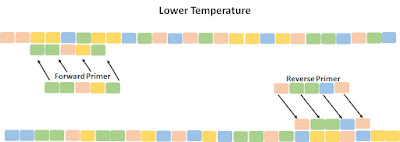
Along with primers, the reaction medium contains “building material” to complete the new double helixes: A, C, G, T, and polymerase enzyme. Primers binding to the chains trigger a polymerase chain reaction.

This reaction occurs only in the presence of a primer specifically attached to a chain. So, the second chain is quickly built over each of thermally separated chains. This forms two complete copies of the original double helix, doubling DNA material and creating two molecules out of one. The cycle restarts with the heating of the solution, and four molecular copies are made. Each subsequent cycle doubles number of copies.
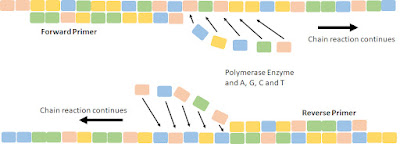
We now have many millions of copies of DNA; not just any copies, but importantly, copies of the small DNA fragment that we are interested in. Proper selection of the primer pairs allows us to pick up only the part of DNA of interest, and amplification occurs only for that part of the molecule between forward and reversed primers. Thus, we narrowed down our area of interest and created a huge number of identical DNA pieces for further investigation.

How difficult is to run PCR?

Running PCR is an easy task nowadays, though it was a challenge to develop. A user receives a kit with everything that is needed in a tube. Users simply add a DNA sample into the tube, close the tube, set it into a PCR thermocycler, and press a start button. The process is usually completed in about one hour.

Does PCR always work properly?

Just like any process, PCR is not perfect: sometimes it fails. There are a variety of reasons why amplification might not occur or the wrong molecules were amplified, including simple operator error. However, PCR generally is a very robust, reliable technique with very low rate of failure.

What happens when PCR is done?

The final PCR product (called the amplicon) provides a fair amount of molecules for subsequent pathogen-detection steps, since PCR alone does not yet answer a question on presence/absence of a pathogen DNA in the sample. PCR simply provides the amplicon to more accurately determine a pathogen’s presence.

There are multiple methods — some more complicated, others less so — to answer this main question. Some only identify the presence/absence of any amplicon in PCR product. Certainly, if there is no amplicon, there is no pathogen in the sample. But these techniques may provide false positive data, particularly if the PCR process amplified the wrong molecules. Other techniques provide data on a structure of amplified molecule, and thus are pretty robust in terms of a rate false positives.

Nevertheless, when you’re looking for pathogen “suspects” via DNA-based methods, PCR amplification will be at the core of the process you’re going to use, and after reading this post, you will hopefully have a better grasp on how PCR works.

— Andrei Gindilis, senior scientist, andrei@werfoodsafety.com

Monday, December 20, 2021

Kentucky, Illinois tornadoes should have you assessing your severe weather safety plans

Unless you’ve been living under a rock, you’re well aware of the terrifying forces of nature that have hopscotched their way across Arkansas, Missouri, southern Illinois, Kentucky and Tennessee on December 10 and 11th.

A significant tornado outbreak has, once again, destroyed the lives of hundreds of families in the blink of an eye. For those of you in the Heartland of America, tornadoes and severe thunderstorm damage are nothing new. This outbreak has stomped its way into the record books as an unprecedented event — but at least two of the heartbreaking stories of destruction should have you thinking about your safety plan for your processing business.

First, around 8:30 p.m. local time, Dec. 10, an EF3 tornado ripped through an Amazon distribution warehouse in Edwardsville, Ill., killing six people in the building and cutting through approximately half of what looks like a typical “tilt up” facility, similar to those that have been springing up all over the nation’s landscape in recent years. At the time of this writing, it has been reported that many of the casualties were third-party delivery drivers who, in the face of the storm bearing down on the community, were instructed to park their vans outside, enter the facility and head into the nearest bathroom. The building collapsed in on them under the tremendous strain of the tornado winds.

My initial reaction to the numerous complaints and articles about worker safety at Amazon, admittedly, was that complaints ignored the randomness factor of a tornado — as though anything less than a direct hit would have caused the same type of damage.

For all those complaints, Amazon’s employees at the facility appear to have gone to the appropriate shelter and had time to do so. Thus, the unfortunate issue here is that Amazon may not have thought two steps ahead to its delivery drivers who might scramble to the distribution center for safety rather than go home or find shelter elsewhere.

The second catastrophic direct hit in this outbreak that should also have you assessing your severe weather policies and the communication around them is the tornado that leveled the Mayfield Consumer Products candle processing facility in Mayfield, Ky. Eight people died in this facility, and there are already lawsuits and accusations flying around the actions (and inaction) of management at the company and facility.

For you, the processor, this should serve as a gut-check for you. In the meat industry, we’ve all been in that “busy season” just as Amazon and Mayfield Consumer Products was when the tornadoes hit. Many of you have facilities built in similar fashion to these buildings.

Now is the time to make sure everyone who is affiliated with your facility knows your severe weather policies clearly and thoroughly. They need to know that “seasonal” throughput doesn’t outweigh employee safety. After that is clear, they must know where to go when there are only seconds to spare to ensure their safety.

When was the last time you explained these things to your management teams and your workers? When was the last time you truthfully ran your plant personnel through a tornado drill? Do third-party vendors know what to do when severe weather hits? Are there in-plant champions and leaders who can direct visitors to the proper areas quickly and efficiently?

When you receive tornado warnings on your phone, what’s your first inclination or move? As a society, we often become desensitized to the warnings, believing it couldn’t happen here, or that the tornado could just skip right by or over us.

Certainly, had these tornadoes made a slight wobble left or right, we might not be lamenting the loss of so many workers in either of these facilities. But you cannot roll the dice that a tornado will do anything predictable. And you shouldn’t roll the dice with your employees’ lives either.

Be prepared, make sure your people are prepared, and then hope for the best.

— Andy Hanacek, vice president of Communications, andyh@werfoodsafety.com

Monday, December 6, 2021

Our ‘Swiss Army Knife’ consultants can help in so many ways

The consultants at We R Food Safety! are pretty amazing in terms of the capabilities we possess. We offer a wide variety of services. In fact, there are still a few clients out there that do not know of all of the services that We R Food Safety! consultants can provide, so if you were wondering, you’re not alone. Being in the trenches as a consultant myself, I’ve listed out many of them below, and you should take advantage of them if you’re not already, simply to: 1) reduce risk of unsafe product 2) reduce food waste, and 3) secure yield. 

Completing “deviation reports” is just one service we provide. If a cooked product does not meet your fermentation, lethality or cooling temperatures — and you have enough data — we are able to utilize many online tools and our expertise to potentially save the product. Now, I will make it very clear right now that we will never suggest saving product that could potentially contain pathogenic organisms, and in many instances, you will have to send the product for testing to ensure microbes have not grown. However, this is a better alternative than throwing out whole batches of product because there was a cooling deviation of, say, 10 minutes beyond what Appendix A allows, or if a smokehouse went down and product sat at a questionable temperature for some time. Imagine the cost saved from not having to destroy that product!

We also serve our clients by assisting them with Food Safety Assessments (FSAs). Having an FSA is simply the reality of being USDA-FSIS inspected. We R Food Safety! consultants can help provide answers to the EIAOs during the assessment. Similarly, we can help plants decide if a Non-compliance Report (an NR) is worth appealing or not. Further, we can help clients appeal the NR, or implement corrective actions if the finding was just. 

Assistance on third-party audits is one of our more substantial service offerings, and that has taken up a lot of my time lately, as well! The Global Food Safety Initiative (GFSI) has set standards for food processors to meet. This includes SQF and BRC audits. I have been the primary consultant building and implementing plans with clients as of late and am coming away with successful audits. These audits are not going away and are heavily customer-driven. My job is to ensure there is no ambiguity when working through the audit requirements, as well as building the policies and forms for clients to comply, and ensuring clients understand these records and documents.  Most customers of meat processing facilities are requesting (demanding) that the processor have successfully been certified as a third-party audited company. 

For clients who use these services, we thank you! If you are not yet a client, or are a client who might be unfamiliar with these offerings, we hope that We R Food Safety consultants can assist you here as needed in the near future! We have loads of experience and expertise on staff here, and we hope that we are maximizing it to help the industry keep the food supply and consumers safe.

— Abbey Davidson, food safety consultant

Thursday, October 28, 2021

Best practices to keep Salmonella at bay

If you’ve been keeping your eyes on the food safety news of the last few months, you’ll have noticed that an outbreak of Salmonella is ongoing in the United States. As of Oct. 28, 2021, 37 states have been affected and more than 650 people have been reported sick, with 129 hospitalizations. No deaths have been recorded as of that date. Although the number of illnesses attributed to this outbreak is high, it is possible the actual number is much higher in that some people did not report their symptoms.

The outbreak is being traced back to whole, raw, red, white and yellow onions from ProSource Produce LLC and Keeler Family Farms. These onions were imported to the United States from Chihuahua, Mexico. Since onions typically feature a shelf life of up to three months, there is a possibility of product still being in commerce. The contaminated product is being sold in mesh sacks ranging from 50 to 2 lbs.; and cartons ranging from 50 to 5 lbs.

Salmonella infection causes an illness called salmonellosis. The symptoms can show up anywhere between six hours and six days after infection. Symptoms typically last between 4-7 days and usually can be resolved without medical treatment. Thus, it’s particularly difficult to track and accurately count the number of people affected. Salmonella lives in the intestines of humans and animals. People can become infected by eating contaminated food or drinking contaminated water, or via direct contact with infected animals.

How do processors help consumers from becoming infected? First, it is important for both processors and consumers to be aware of pathogen growth and have controls in place to prevent growth from occurring.

Things processors can do include: meeting lethality requirements, receiving COAs, maintaining storage conditions, have pest control plans in place, monitor air quality, have an employee health policy, and ensure proper water drainage.

We all know raw poultry and eggs are known sources of Salmonella, and that reaching lethality during processing will destroy it. However, Salmonella is also common in dry conditions. and difficult to detect there. It can be killed by heat, but that won’t help prevent contamination if it is present in ingredients applied to already cooked product. Therefore, it’s crucial that processors know their dry-goods suppliers and receive COAs, to prevent contamination of already cooked product.

Another thing to be aware of is pest control. Pigeons, rats and mice are known carriers of Salmonella in the food industry. Even if you don’t have these pests in your facility, be aware that Salmonella can still enter the plant via employees’ boots or forklifts that drive outside and back inside. Use of boot wash stations and cleaning of forklift tires can help maintain sanitary conditions and keep pathogens like Salmonella from infiltrating the facility.

The environment of the facility is also a big factory. Plants located in rural areas may need to monitor air quality at a higher level and change filters more often. This is particularly important if the plant is near a farm, as contaminants could enter the plant via the ventilation system.

Humans can also be a source of Salmonella entering the plant if they are infected and continue to work. All employees should be washing their hands properly and staying home if they are sick. Facilities should log employee health, and if an employee went home sick, the reason they went home should be recorded. This is confidential information that should not be shared, but it may turn out to be helpful should a recall happen.

Water is not a source of Salmonella, but it can aid in the survival of the pathogen in the plant environment. Proper drainage that prevents water from pooling decreases the chances that Salmonella will survive and grow.

For consumers there are a few key things to do to help prevent getting sick. Processors should always remind their consumers to follow these guidelines. Consumers should clean, separate, cook and chill.

Washing hands, utensils, and any produce reduces the risk of cross-contamination. All produce should be washed prior to cutting or peeling to reduce pathogens. Hands and utensils should be washed in between contact with raw and cooked foods.

Separating food that won’t be cooked from raw meat, poultry and seafood limits chances of cross-contamination. Not only is this important during meal preparation, but it should be considered when putting groceries away. Raw products should be kept on the bottom shelf of the refrigerator to prevent any leakage from dripping on to ready-to-eat foods.

Cooking food thoroughly eliminates the chances of obtaining Salmonella from raw product.

Chilling perishable foods within two hours of being out, and thawing food in the fridge instead of at room temperature, both limit the possibility of pathogen growth.

Salmonella is a common, pesky pathogen that is difficult to eliminate should it enter your plant. It is easier to be aware of how Salmonella can enter your facility and have controls in place to limit the ability for it to grow. By instituting and installing as many of the preventative measures mentioned above, processors and consumers can safely enjoy foods without as much concern for getting sick from Salmonella.

— Sam Bibbs, food safety consultant, sam@werfoodsafety.com

Thursday, October 21, 2021

Gen. Colin Powell, my idol, and a real American hero

Well, it has just been a crummy week for the team. One member just found out a close relative has days to live, another is looking for an answer, but the preliminary is something no one wants. Meanwhile, other team members are hearing sad and stressful news about loved ones. As I said, it appears to not be a great time for the psyche of our team.

For me, I lost one person whom I believed to be immortal. Although that person was not perfect (no one is), he damn sure exemplified perfection when he could. I’m speaking, of course, about General Colin Powell, who passed away earlier this week.

There are so many stories about him, I shall not repeat them. Just take a look at his awards. Here are some things I remember: The image someone carried out of fire fight the year I was born. Disagreeing about strategy and prevailing as he moved up the ranks. Developing a combat doctrine that said: Don’t fight if you cannot win; sacrifice no one for the sake of sacrifice. Stopping and asking a sergeant (who was doing a bit of hero worship): “Where are you headed” and then providing directions.

Gen. Powell exemplified what I aspire to be. He was a human, a leader, a real American. He was what Americans are supposed to be: real people — not perfect, but real, in that they do what they believe.

You may disagree with that basic premise, and that is your right — a right he fought hard for you to keep, by the way. I didn’t cry in front of my team when I heard he had passed, because they don’t know who he really was and is to me. I needed the time to pull this together, which led me to realize just how important Gen. Powell was to me — and now my team will know as well. 

Gen. Powell was (and will be remembered as) an American hero. He is, was, and will always be “The General.”

Gen. Powell, you are, and will always be, a true American that held to the ideals of America, even when others tried to pull you down. Thank you for your service, but especially thank you for motivating this punk from Menomonie, Wis., to always strive for perfection. Yes, we can’t reach it, but we can always try. Lesson learned.

RIP, General!

— Andrew Anthony Lorenz, SFC (Ret)


Wednesday, October 6, 2021

Senator’s stop at Sailer’s sparks speculation about success

senator baldwin at sailer's
Recently, U.S. Senator Tammy Baldwin (Wis.) visited Sailer’s Meats in Elmwood. Sen. Baldwin toured Sailer’s along with several other meat processors from the area — and yours truly!

During the tour, Jake Sailer pointed out equipment and explained the processes, as well as what it cost to modernize in his current location.

We then did a very short Q&A about the current location, which was designed and built out approximately 10 years ago in the heart of the small town. With the changing business environment, however, Sailer’s has outgrown the facility based on the product demand they’re seeing. At this point, we headed to “Sailer’s 3.0” — the new location near Interstate 94 — toured that location and had another Q&A with Sen. Baldwin. 

Understand, this wasn’t a “photo-op” visit; it was a chance for Sen. Baldwin to see first-hand what it takes to run a growing business in the meat industry and learn the real costs associated with modernizing a small to mid-size facility.

During the discussion, the topic of women in the workforce and in ownership/leadership roles came up. We also discussed automation and the unique position small and mid-sized meat- and poultry-processing facilities found themselves in when the COVID-19 pandemic hit. 

The challenge to grow a small meat and poultry shop into a mid-sized one really boils down to how much capital can be secured. Equipment costs are very high, and when you look at the cost of building the facility, let alone the necessary refrigeration, and the struggles to attract additional employees, acquire automation, etc., it rapidly becomes unattainable for the average small processor.

Sen. Baldwin has helped already by pushing for funding in the American Rescue Plan, which is geared to strengthening the food supply chain. She was keen to hear how the funds would be used by small plants to modernize and retain employees, and how the food supply chain is being strengthened by smaller, local facilities.

The meeting caused me to step back and really put a critical eye to our supply chain. Looking out the home-office window, I am surrounded by farmers who are the first link in that chain. I work with processors and distributors daily, and at the end of the day, I am a consumer. 

I believe we are seeing a fundamental change in how we supply food to the American public. Mega plants that maximized efficiency also have an Achilles’ heel; the pandemic shined a light on the fact that those very things that made them efficient also made them vulnerable. 

The facilities that weathered this storm the best were the small and mid-size facilities. Those that had invested in automation and employee protections early on had the least amount of disruption.

What’s the future hold? I see a need for all sizes and types of operations. Having said that, I do believe that most of the growth is going to be in the mid-size to small, multi-facility companies. Those businesses are small enough to serve the local community, but large enough to take advantage of new technology and leverage innovation. 

I applaud Sen. Baldwin for reaching out to industry, learning first-hand about the process, and investigating how she might help them grow to ultimately support the local communities, towns and cities that surround them.

This brings me to an innovator and entrepreneur we recently lost far too soon — Andy Shaw of Cypress Valley Meat Co. Andy not only believed in small, local, community meat and poultry establishments, but he proved that they could grow by providing burst capacity to larger communities, all while still supporting the local communities around them. He leaves us a great example of how small processors can win, and he will be missed!

— Andrew Lorenz, president, andrew@werfoodsafety.com


Thursday, September 30, 2021

Scientists toilet-training cows: crazy or smart?

I recently read an article published by Bloomberg that caught my eye: “Scientists Are Toilet-Training Baby Cows to Cut Emissions”. I’m including the link in case you haven’t seen it.

A couple of my colleagues here at We R Food Safety! asked me, the official, professional scientist on staff, if I had any comments on the research, and if I’d write a blog about the craziness of the whole thing. Regarding the research, what more can anyone say? The title speaks for itself. My reaction to the studies, however, requires more effort.

In short, to me the toilet-training experiment does not make any sense — not scientific, economic, environmental or any other. There is a Russian witticism: “If you want your cow to eat less and give more milk, just feed it less and milk it more.” Sounds logical, no? So, basically, these scientists are at approximately the same level of pragmatism as that Russian witticism. 

That portion answered, are they crazy? The answer — maybe surprising to you — is: Not at all. They are perfectly sane, and simply taking an advantage of today’s situation, which is: Any studies done under an umbrella of saving planet Earth get funded and get public attention. Public attention is then converted to funds again. And the show goes on. 

With this in mind, I would suggest (free of charge!) a few similar scientific topics that these researchers might use as a follow-up to their toilet-training study: 

  1. Scientists Train Baby Cows to Lift Weights to Improve Digestion and to Cut Emissions. (for bonus fun, replace weightlifting with dancing, singing, hopping, etc.) 
  2. Scientists Are Sauna-Training Baby Cows to Sweat More and Urinate Less to Cut Emissions.
  3. Scientists Teach Yoga to Baby Cows So They Breathe Less to Cut Emissions.

If you haven’t figured out by now, the algorithm is clear. The key for researchers is to Cut Emissions from cows. I patiently await the mainstream media articles covering these crucial, potential, Earth-saving studies.

To return to the matter at hand, however: The idea to help the environment and save the planet remains important, for certain. However, I wonder how much funding that could be used for real research is wasted on studies like these, which appear crazy or ridiculous, but are a product of the publicity and funding mechanisms in place?

— Andrei Gindilis, senior scientist, andrei@werfoodsafety.com

Friday, September 17, 2021

Uncovering nuggets of insight during the Missouri bus tour

This was my first year on the bus tour with the Missouri Association of Meat Processors (MAMP), and I have to say, it not only was educational but also was a blast. One of the things I love about our business is all the great “salt of the Earth” people I get to work with. It never fails to be a good time when I get around a bunch of processors. Yet, the trip wasn’t all good times and no business — it consisted of visiting five processors that ranged from custom to USDA inspected.

I’m not going to lie and tell you that it wasn’t a long trip. We covered a lot of ground and were all wiped out at the end, but it was worth it. Niki Cloud of MAMP put together a wonderful educational trip. Not only did valuable friendships emerge and old ones get reinforced, but a lot of information you can’t get anywhere but in person was exchanged. I would love to see all the state associations adopt this fun way to congregate and learn. 

I have to call out Kurzweils’ Country Meats (owned by the unstoppable Chris Kurzweil) as a real delight. His plant has been designed for growth, and considering how good his Burnt End Brats are, he is going to need all that room soon enough. Chris is one of those humans they forgot to put the quit in. Years ago, his plant burned down, and through his relationship with fellow processors, he was able to continue to fill orders until the plant was rebuilt. The fire gave Chris a chance to turn lemons into lemonade and design the plant he always wanted.

His new plant had several features that I liked and wanted to point out to you. First, all the walls throughout the entire facility feature 9 inches of insulation, which is a huge up-front cost but saves money on the back end. Chris also laid out the plant process flow in the shape of a circle from start to finish. Product never has to cross back over any area, it just continues into the packaging room. Chris does a lot of co-packing work, so having a dedicated packing room and yet another for labeling is a huge advantage. 

One of the coolest features I saw, however, is the sanitizer, which is located centrally in the building and has nozzles that go into every other room of the plant. This eliminates a lot of traffic and keeps things simple. He also came up with the idea to avoid potential boil order issues in the area by connecting his sanitizer (chlorine dioxide) to his water storage tanks. There may never be a boil order in the area, but if there is and he finds out after a day of making those fabulous brats, he won’t have to worry about the product. That is good, old-fashioned Missouri logic right there, and I like it! Hope for the best but prepare for the worst!

Chris doesn’t mind talking with other processors about his plant and sharing his knowledge. He even gave me permission to put his phone number in this blog, just in case anybody has questions (I’ll put it at the end for you, so it’s easy to find — more good, old-fashioned Missouri logic right there too!). In exchange, he asked me to add a comment about his dashing good looks and how extremely humble he is despite those good looks. Did I mention that he also has one heck of a great food-safety team here at We R Food Safety! backing him up? I happen to be his consultant. Along with having a propensity for excellent logic, we Missourians are very humble people — did you not know that?

On the bus tour, we also visited Hertzog Meat Co. in Butler. This is a very new and beautiful plant. Todd and his crew hit the ground running. I was there on the first day of slaughter a few months back (we posted about it on our Facebook page!). He is another one of those Missourians they forgot to put the quit in. They have been processing for only about 90 days now, but they already are doing a bang-up job. Congratulations to the Hertzog family for landing their product in Hyvee supermarkets so darn quickly! Like Kurzweils, Hertzog also has extremely good taste in food-safety software companies, just saying. Their QA person, Kassy, has taken the challenge on with great enthusiasm and doesn’t let a thing get by any of them.

Dinner during the bus tour was at Lockwood Packing Company in Lockwood, inside the 35,000-square-foot addition that is being built. Lockwood is gearing up to do 50,000 pounds of snack sticks a day once the addition is up and running. Like everybody else they’re concerned about finding enough labor to run the plant at full capacity. That will bring special challenges, but they hope to be one of the major employers in the area soon and hope that will help them attract workers who might typically commute to the bigger cities for work. I think they will be able to do that. 

We also visited R-H Processing in Rich Hill — which is a custom plant that has been in the family for two generations — and state-inspected Hetherington Meat Processing in Clinton. So much good information is passed back and forth at these meetings. On the bus we were lucky enough to have representatives from the Missouri Department of Agriculture and the University of Missouri Meat Lab.

With deer season just starting in Missouri for bow hunters, one heavily discussed topic on the bus was deer processing — with some of the passengers looking to increase the amount of deer they process and others looking to cut back and focus on other species.  Meanwhile, it was mentioned at Hetherington that they have stopped taking bone-in deer, as other avenues are so much more profitable. Those types of knowledge nuggets are, frankly, industry gold — and they can’t typically be discovered in a Zoom meeting or conference call!

I can’t wait for my next tour! Maybe someone reading this will let me be the tour guide!

— Martha Gore, food safety consultant, martha@werfoodsafety.com

Note: Chris Kurzweil’s phone number: (816) 590-0447. (Admit it, you thought I’d forget!)

Monday, July 26, 2021

Tyson recall offers chance to revisit Listeria-prevention best practices

Given the major recall of Tyson Foods ready-to-eat chicken product that made national headlines earlier this month due to possible Listeria contamination, I thought this would be a good opportunity to touch on what consumers and processors should be aware of when it comes to Listeria. Listeria, specifically Listeria monocytogenes (Lm), is a bacteria found in moist environments, soil and vegetation; it can transfer from the environment, employees or raw food onto ready-to-eat (RTE) products.

When consumed, Lm can cause listeriosis. It is estimated that 1,600 illnesses, 1,500 hospitalizations and 260 deaths happen each year from listeriosis. Due to the ability for Lm to grow at temperatures as low as 34 F, it is usually found in the environment, and it is considered a harborage organism. This can be especially dangerous in situations where improper sanitation allows RTE foods to come into contact with raw product.

As a processor, there are quite a few things you can do to control Lm in your facility. These include proper product handling, effective cleaning and sanitizing, facility controls, and employee practices.

Proper product handling is especially important for RTE products. One important measure is to keep product at or below 41 F, as this slows the growth of Lm and decreases the risk. If possible, it is a good idea to also incorporate an antimicrobial agent into your product formulation. A few examples are acetic acid, lactic acid or citric acid. These acids can have an adverse effect on your desired flavor profile, so they’re not always the right solution. It is also essential to separate product that supports Lm growth from product that does not to eliminate cross-contamination; this includes separating raw product from RTE product.

Cleaning and sanitizing are another effective way to limit Lm growth in your facility. This includes following your SSOP and ensuring that employees are properly trained on cleaning and sanitizing protocols. It is essential to maintain sanitary conditions throughout the day and re-clean and sanitize as often as necessary.

Since Lm is frequently found in the environment, it is a good idea to routinely sanitize items and areas that are often touched by employees but are not food-contact surfaces — items such as light switches, equipment handles, display cases, etc. — to prevent cross-contamination. Your SSOP should include disassembly of equipment for sanitation  if possible, to ensure the equipment does not pose a contamination or harborage threat. Following the sanitizer manufacturer’s instructions on mixing sanitizer to a proper strength is also critical to ensure you are cleaning properly. It also might be a good idea to switch up the types of sanitizers you use to prevent Lm at your facility from becoming resistant to one type.

Facility and equipment controls should also be included in your SSOP. Condensation dripping on product, for example, could cause Lm contamination. You also should use materials that are easy to clean. Ensuring proper floor drainage will also help combat Lm, by not allowing water to sit on your floors and potentially be splashed onto product.

Good practices around employee hygiene can help reduce your likelihood of Lm in your facility as well. Cross-contamination, again, is the major concern here. Use of disposable gloves by any employees handling RTE product and proper training on personal sanitation protocol helps keep your facility sanitary and prevent the harborage of bacteria and pathogens. To further assist your employees in keeping product safe, you should provide adequate soap and hot running water for them to wash up before entering the production areas. Provide clean frocks for employees to wear, and the ability to change frocks as they become contaminated in order to keep employees from spreading contaminants in the facility on their personal clothing.

Consumers should also be aware of steps you can take to prevent Listeria growth. These include chilling food properly, using RTE foods quickly, maintaining a sanitary environment, cooking food properly and knowing which products are risky.

Chilling food helps reduce the ability of the pathogens and bacteria to grow. Refrigerators should be set at or below 40 F — if your fridge does not tell you the temperature it is recommended that you purchase a thermometer to monitor the temperature.

Using RTE foods quickly can also lessen your chances of listeriosis. Use food by the “best by” date to improve your chances of staying healthy. The longer food sits in the fridge, the more time Listeria has to grow.

Just like in the processing environment, consumers must maintain sanitary conditions in the kitchen. This includes keeping your fridge clean, cleaning your hands and utensils, and separating areas and cutting boards between raw and RTE product.

Proper cooking is also important. Food should be cooked to 145 F for whole red meat, 160 F for ground meat, and 165 F for poultry. The best way to monitor this is by using a food thermometer so you can ensure that the temperature was reached without over-cooking your food and decreasing palatability.

Some foods carry more risk to consume as they have been known to cause listeriosis. If you are over 65 years old or pregnant, the Centers for Disease Control and Prevention (CDC) says you should especially be aware of these. Some products include hot dogs/deli meats, soft cheeses, unpasteurized milk and refrigerated smoked seafood.

Pathogen prevention should be of high importance to both processors and consumers. Both are responsible for preventing food borne illness. If you do believe you have a foodborne illness, contact your health-care provider and report the suspected illness to the USDA or FDA by visiting www.foodsafety.gov.

Although large recalls similar to the recent one with Tyson happen now and then, and they should be reported widely, if you follow the guidelines and protocols, the chances of Listeria becoming a problem for your products or your consumers can be lessened.

— Sam Bibbs, food safety consultant, sam@werfoodsafety.com

Thursday, July 22, 2021

Personality training can improve work with clients, internal communication and efficiency


In mid-June, the We R Food Safety! staff traveled to our Menomonie, Wis., headquarters for a week of meetings that included individual and team growth, software and food safety meetings — and some very good food. One training session that the entire team experienced was a presentation and analysis of our personalities in the workplace setting, following the DiSC model. Weeks before our team meetings, we each took the personality quiz, and were then presented our own personality profiles. At the team meetings, we learned more about how those profiles can coexist. From the DiSC Web site (https://www.discprofile.com/what-is-disc), here is a brief explanation of the personality profiles:

DiSC is an acronym that stands for the four main personality profiles described in the DiSC model: (D)ominance, (i)nfluence, (S)teadiness and (C)onscientiousness.

People with D personalities tend to be confident and place an emphasis on accomplishing bottom-line results. 

People with i personalities tend to be more open and place an emphasis on relationships and influencing or persuading others.

People with S personalities tend to be dependable and place the emphasis on cooperation and sincerity.

People with C personalities tend to place the emphasis on quality, accuracy, expertise, and competency.

I found this training to be a valuable course in understanding more about each individual, as well as how they function within the larger ecosystem of a team. For example, in working with clients, it is fun to guess which category each client may fall into. Stereotyping is a faux pas, so that is not the goal or intention here. However, being able to identify the personality profiles of people and adjust to them has aided in further understanding of client needs and helping get tasks completed more effectively. 

I have a very strong “D” personality. This means I do not focus as much on emotion or the journey of a task, but rather focus on achieving a goal or task at hand, no matter the path. 

Having gone through the session and discussing the personality profiles of our team members — and how we all might better communicate based on them — I recommend this type of training to anyone that either has an issue with team cohesiveness, or very heavily focuses on the health of each team member within their facility!

— Abbey Davidson, food safety consultant, abbey@werfoodsafety.com

Tuesday, July 6, 2021

10 steps to protect your operation against cyberattacks

I just finished writing an article about cybersecurity targeted for a wider processing audience, and even though they didn’t put a strict word count on me, there simply wasn’t enough room for the article to get down into the weeds of prevention, particularly for the small processors.

If you read the article (coming soon to ProvisionerOnline.com, and will be linked here), you should come to realize that no one is immune from cyberattacks these days. The belief that “I’m too small to be noticed or hit hard,” is misguided at best and a crock at worst.

So, exactly how does a small operator protect itself from cyberattack?   

Here are my top 10 thoughts on what you can do:

1) Use real passwords.  A minimum of 12 digits, use numbers, special symbols, caps, etc.  Do NOT share them!  Change them often.

2) Use a network firewall on your incoming Internet connection, not just a router — and don’t rely on the Windows computer firewall as your only line of defense.

3) The QuickBooks computer needs to be on its own network and only limited people can have access to it!  Encrypt your data!

4) If you have WiFi for your customers, keep it on a separate, isolated network.

5) Limit the duties or capabilities assigned to in-house computers.  If you have a smokehouse computer, for example, then just use it for the smokehouse, not for surfing the Internet!

6) Update your computer operating systems!  Security updates are often deployed based on an active threat.

7) Segment your network. Your guest access WiFi, for example, should not be connected to your main network, and your finance/point of sales system should have its own network. Everything should be siloed so that the bad guys can’t take everything down in one or two shots.  Computers used to connect to email, surf the Web for research/social media, etc., should be isolated to a separate network and should be identified in your firewall as high-risk devices.

8) Have an outsourced IT expert review your setup; and when you look at the ROI on this move, imagine having to replace every computer in your shop, the lost time, the lost customers, etc., versus what becomes a minimal cost of having an expert set up and maintain your systems.

9) Look at your options and determine what your level of risk is.  If you are a super-small shop with two computers and a basic Internet connection, it might make the most sense to simply add a firewall box. You can get one with a very good next-generation firewall for less than $300.

10) If an employee leaves your company and they had access to your networks, you need to change the passwords ASAP!

At the end of the day, cybersecurity information can appear overwhelming — there is a lot of information on how to protect your business — but you must educate yourself and your team.  Make sure your team understands that your business systems are not meant to be used for surfing the Web and that passwords cannot be shared.  Finally, at the absolute very least, please run virus/malware protection. Windows ships with built-in security tools, please use them!

— Andrew Lorenz, president, We R Food Safety!, andrew@werfoodsafety.com

Tuesday, May 25, 2021

First foray into processing plants shows COVID preventions still in place ... and apparently working

 For those unaware, not only do I work for We R Food Safety!, but I'm also the editor-in-chief of the industry trade publication, The National Provisioner. I've been working for NP for more than 15 years now, covering all the innovation and attempting to share the great work the industry has done during that time (since the mainstream media isn't always the most helpful when it comes to that).

One of the primary tenets of my role with NP is to visit processors to see, learn and share details of successful initiatives, innovation and great ideas! These articles could be fielded over the phone and email, but we've always held the belief that readers wanted to see our editors learning first-hand, in-person. Even through the worst of the Great Recession, I traveled the country to report on "cool things" happening at plants all over the place.

So, as you might expect, the last 15 months of the COVID-19 pandemic had burned a hole in the very fiber of my being on NP. Although I don't relish spending hours in airports, airplanes and rental cars, I *do* very much relish the personal connections and eyewitness education I get when visiting these facilities and meeting the people.

Last week, finally, I got back on the road. I visited two processing plants in south Alabama for our upcoming June eMagazine cover story. I wasn't sure what to expect out on the road for the first time in 15 months, and there were some things that surprised me -- and some that did not.

First, all the COVID-19 precautions were in place and running smoothly at the plants I visited. Temperature screening to get into the plant was a cakewalk (and pretty sweet technology, if you ask me!) with no bottlenecks or problems. I did come in between shift changes, but still, the way it was set up appeared solid.

Although the absence of them in many public areas in south Alabama was a bit of a shock to the system for this Chicago resident, with regard to face coverings, everyone in and around the plants had them on. Then again, with the amount of personal protective equipment worn in "normal" times, a face covering on a plant worker isn't really a stretch.

Lastly, partitions were still up and being maintained all across the processing floor and in the break areas. The partitions were probably the most "odd," as I am used to getting up on a ladder or catwalk and taking in the entire processing floor from above. But with the partitions in place, it looked more like a stainless-steel individual cubicle farm, rather than a smoothly running disassembly line. Indeed, product was still running smoothly and workers had plenty of space to perform their tasks, but there was a certainly level of what I might call "loneliness" that I thought I'd feel if I had to work in one of those areas.

It was great getting out on the road again. And despite media reports of people getting kicked off planes for not wearing their masks, there was no one on my flights who caused any kind of ruckus. Everyone did what they were supposed to do: Follow the rules to keep people safe. I didn't even hear complaining, honestly. Well, not any more than a normal flight might see.

So, keep up the great work protecting your employees, obviously without sacrificing food safety and quality along the way. After a bumpy start, the industry engineered solutions that work. Let's keep them in place!

Friday, May 7, 2021

Cultured, 3D-printed ‘Frankenmeat’ has a long road ahead, but can’t be ignored

When I first heard of 3D-printed and “cultured meat,” I was once again thankful that when I die, I will not be leaving behind any children to live in this crazy world. Having had so many years of experience in the plant-based, meat-alternative business, however, I also decided that I still should educate myself on these matters.

The companies selling these meat alternatives have some very trendy arguments for why they are a good idea. They say these products can be created with a smaller footprint, meat protein can be grown in an incubator much faster than on the hoof, animals are not put down for the process, and well, gosh golly darn it, we just have so many more people that need to be fed nowadays.

I can see how these products could be considered useful in some of those respects: For example, if you lived on a small island or perhaps a space station, that all sounds good. However, lots of things look good on paper until they hit the real world. You can find people who all thought Communism, extended warranties and New Coke sounded good at one time or another — just saying.

To create 3D-printed meat, you start by removing stem cells from an animal, placing them in a petri dish and putting them in an incubator to replicate. Once enough cells are present, they are then made into a paste, which is put into a printer cartridge then placed in the printer — much like a typical ink cartridge — and printing begins.

The process of “printing meat” reminds me of cake decorating. As a matter of fact, the process can create some interesting shapes, but so far, I haven’t seen any that look like a chicken breast or steak. So, perfection/improvement of appearance and texture are still on the drawing board. The first finished product printed was a breaded chicken nugget. Did I fail to mention that Kentucky Fried Chicken is championing this research? No word yet on whether Colonel Sanders is rolling in his grave.

Anyhow, taste testers reported that it tasted just like a traditional chicken nugget, but when cut open you could see that it was a mass of goo that had bubbled during the cooking process. I do not think that alone would deter chicken nugget fans though, because it really doesn’t look all that different from a cooked, meat-taken-from-the-bird McDonald’s McNugget.

When it comes to beef, they would likely follow the same process to make a paste and are working on a beef burger. As you might imagine, the companies competing for this market share are very protective of their processes, so I was unable to find footage on how they were trying to achieve the coarse-ground look.

Naturally, printing burgers isn’t the only target for these entrepreneurs. (Writer’s note: Naturally? Printing burgers? I’m not sure those go together!)  Some companies are already growing steaks. At the point of this writing, it had been reported that the cost of a piece of cultured steak the diameter of a credit card and about twice as thick is around $60,000 — and doesn’t feature the fibrous muscle tissue look of real steak. The ultimate goal would be to produce Wagyu in a lab setting, which clearly is going to be a few years away.

None of these products are ready to hit the market yet, nor are they approved for sale in the United States. On March 7, 2019, the USDA and the FDA agreed to jointly share regulatory oversight of these products. Two years later, the details are still being ironed out. What I do know is that my own state, Missouri, passed a law saying that meat cannot be called meat unless it comes from a traditionally raised animal. This gives me hope. What the labels on these cultured-meat products will say in the future is anyone’s guess at this point. My only concern is that it must be clear to the consumer. 

This new technology could prove to be a challenge for the meat industry, although I do not see that happening very soon. I also see that there could come a time when traditionally raised meat is much more expensive and sought after. Whatever happens, this is an issue to keep an eye on, and it is important that each state get on the Missouri bandwagon and pass laws now that require meat to be defined as traditionally raised.

— Martha Gore, food safety consultant, We R Food Safety!

Tuesday, April 20, 2021

Product claims: Common sense, education must prevail

As a 22-year-old who spends her fair share of time on the Internet and is employed in the food industry, I have come to notice a lack of knowledge the average consumer has about food. Indeed, I’ve noticed that consumers are in the dark about what some ingredients are, how things are processed, and which health claims actually hold value.

But is this gap in knowledge due to the secrecy that often comes with the food industry, or is it ignorance on both sides of the aisle, i.e., consumers think they shouldn’t have to take the time to understand how things are made and what different claims mean, while processors might not believe it is their responsibility to inform consumers? This gap causes a lot of confusion and misinformation to be spread.

One common problem that comes from this gap are consumers who get worked up over the ingredient lists and nutrition labels on so-called health foods. Labeling requirements as they are, these so-called health foods do contain quite a lengthy list of ingredients. Compounding matters, when companies utilize ingredients fortified with other ingredients, they must all be listed in order, creating long labels with ingredients that can sound mysterious or be difficult to pronounce.

Recently, I came across a tweet about a surprise finding in a box of cereal. The post was tweeted by a comedian who claimed to have found shrimp tails in his Cinnamon Toast Crunch.

Based on how cereal is produced and the assumption that General Mills’ quality-management strategies aren’t in question, I didn’t believe it. Furthermore, anyone who fell for it must not have thought through this very much. It had to be a joke, I thought.

Unfortunately, consumers who post social-media messages like this — maliciously or not — often have little idea the serious ramifications of their claims. Doing an entire recall for a social-media practical joke would be a nightmare! The fact that some consumers truly believed this comedian found shrimp tails in cereal, even for a second, is one scary thought. Because of a select few consumers who didn’t do their own research and/or use common sense, General Mills had to expend effort to manage a phony crisis.

Even with external groups creating misleading claims about products, it doesn’t mean processors aren’t always innocent of making unsubstantiated claims. It amazes me the product claims a processor can make that have little backing or value, even. I have friends who have been misled as to what a “healthy” product is because of many of these nonsense claims, and such labels have become a pet peeve of mine. The most annoying claim so far has been the term “natural.”

For meat and poultry products to be labeled “natural,” the USDA states they must be minimally processed and contain no added artificial ingredients. If that wasn’t vague enough for you, for other foods, the term has no clear meaning and is not even regulated by a government agency! Because of that wide-reaching definition, there’s no perfect way for science to even show that “natural” products are better for you (or not). Thus, they are marketing tactics processors use to convince consumers they are being healthy, a deception that increases the knowledge gap and mistrust the average consumer has with the food processing industry.

All is not lost, however. There are TikTok, Facebook, YouTube users who are bringing the science of food production to the forefront for those consumers who will listen. Although I believe it is the consumer’s duty to be more in the know about food processing, as a food industry employee, I feel a sense of responsibility to debunk some of these myths and add transparency wherever possible. Do you feel the same about educating your consumers? Maybe you should …

— Sam Bibbs, Food Safety Consultant, sam@werfoodsafety.com

Tuesday, April 6, 2021

Minimizing food waste through your food safety tactics

One of the most attractive features of my job with We R Food Safety! is the fact that we aid in the reduction of food waste within the United States.

The Food & Drug Administration (FDA) states that food waste is roughly 30-40 percent of the food supply within the nation. We have people with “food insecurities” (the political way of saying that those people are starving) across the country, yet there are people within walking distance of those with food insecurities who throw out food, often unnecessarily. This just does not sit well with me, and that’s why there are certain aspects of this job that I love so much. 

One of the main ways my colleagues and I aid in reduction of food waste is by running “deviation reports” for our clients, nationwide. If a processor’s product does not quite meet its lethality or stabilization temperature, or a cooler has gone out and we have recorded product temperatures at certain times, we are able to review numerous databases, scientific support pieces, etc., to determine whether the product in question truly is still safe or not. I couldn’t even hazard a guess of how many pounds of product We R Food Safety! has saved for our clients, but the number of pounds saved isn’t the point. The point is: We made sure 1) product was not wasted, 2) product was still safe to consume, and 3) our clients made money on product that would have been discarded and wasted a decade ago due to lack of data and knowledge. That is what matters and helps me sleep happily at night. 

Another way in which we prevent food waste is helping clients navigate the different product outcomes for corrective actions due to their food safety system record-keeping failures or regulatory non-compliances. What I mean by this is, if there is a corrective action related to regulation that isn’t necessarily a food safety issue, the product isn’t doomed to be discarded if we can help identify the difference between paper non-conformities and a true food safety concern. Again, product that is proven to be safe isn’t unnecessarily wasted.

We have a lot of hurdles daily as an industry to overcome, with food waste being a significant one. The industry has made some changes to do its part, but it can do more. The above-mentioned examples are two ways We R Food Safety! staff helps minimize food waste at the processing level. But there’s more work to do. The next hurdle I would like to see tackled as an industry: development and feasibility of biodegradable packaging with emphasis first on raw meat products. 

— Abbey Davidson, Food Safety Consultant, Abbey@wrfs.pro

Tuesday, March 30, 2021

MEATOUT, Meat on the Menu proclamations? Who cares, it’s all grandstanding

A couple weeks ago, it began: Yet another war of words, proclamations and stupid political and media grandstanding over whether consumers should eat meat or not. I’m growing seriously weary of these headlines crossing my news and social media feeds.

I’m also getting tired of saying the same things over and over on this, but please, spare yourself the increased blood pressure, and simply ignore the stupidity. On both sides. All sides, should there be more than two.

Colorado Gov. Jared Polis declared March 20, 2021, “MEATOUT DAY” in Colorado. So what?

Colorado State Sen. Jerry Sonnenburg came out strong against the attack on the agriculture industry in response. SO WHAT?

Nebraska Gov. Pete Ricketts then countered his neighboring state’s move by declaring a “Meat on the Menu Day” in Nebraska. SO WHAT?!?!?!?

Did any of these announcements truly move the needle either direction for or against meat production in either of these states, let alone the country? I say, “Not likely.”

For the last 15 years or so, I’ve been telling the readers of The National Provisioner that there simply is too large a silent majority of meat eaters out there who don’t care what the activists have to say or what the activists do to try and convince them to ditch the animal protein. That’s nationwide, in my opinion: from the conservative small-town and rural ag people, to those darned “lib-ruhls” in the urban areas who’ve never been on a farm. Not a single one of this silent majority would trade his or her pork chops for a new pickup or Porterhouse for a Prius, even if you think they would.

Furthermore, how many people listen to the government about what to eat, when or how? How many people cook their meats properly because the government says that’s the safest move? Does anyone even care about the Food Pyramid or whatever the government might be suggesting for daily intake of foods? Coloradans who loved the “MEATOUT” proclamation likely were already eating less meat, and Nebraskans who loved the “Meat on the Menu” proclamation likely had a big steak ready for dinner that day already.

Let’s remember that, although our form of government means we need politicians in order to represent us, they don’t always do that. And when they don’t represent you individually, you need to measure the gravity of the situation properly.

These proclamations were nothing more than grandstanding for the media and political donors — both left-wing and right-wing outlets (depending on which proclamation, of course). Nothing more, nothing less.

Carry on with your processing — whether that’s meat, poultry or other food product — and when the news starts talking about these dumb proclamations, remember that anyone can request proclamations, at least in most states.

Then, remind yourself that the quality and safety of your own product has much more bearing on whether your customers come back than what your governor says about meat or food in general.

— Andy Hanacek, vice president of Communications, andyh@werfoodsafety.com

Friday, March 19, 2021

Salmonellosis outbreak from ’95 does NOT support humidity as a critical parameter in jerky processing

I just had a rather enlightening conversation with a senior USDA-FSIS official about the need for humidity during jerky manufacturing.

I asked, “How does humidity destroy pathogens?”

The official really didn’t know the answer, but he did state that, without humidity, pathogens can become heat-resistant, and Salmonella can grow and survive normal lethality.

When I asked for the studies that backed up these statements, the official pointed to the same studies they always do. I then explained how those studies didn’t actually take product to lethality (i.e., what was surviving was only surviving longer than the non-treated Salmonella). The official countered by citing the salmonellosis outbreak from 1995 in New Mexico — as is typical of this conversation.

Here, too, the problem with citing that case is lethality, as the product implicated in that outbreak should be considered a raw beef jerky, not fully cooked.

Per the published outbreak report by the CDC (https://www.cdc.gov/mmwr/preview/mmwrhtml/00039423.htm), partially frozen product was placed on racks and was pushed into a drying room. The chamber temperature (not the product’s internal temperature) was set at 140 F for three hours, then reduced to 115 F for approximately 19 hours. Therefore, the product was never exposed to a lethality treatment, and hence, by definition, it was a raw product. The report also states that no product temperatures were ever recorded.  

I promised to send the official the CDC report to remind them (or make them aware) that the production technique that was used resulted in a raw product that clearly wasn’t ready to eat (and that doesn’t even factor in other inputs or lack of them, such as sanitation, equipment, plant elevation, etc.).

It’s a shame this conversation even needed to happen, and that we have to point this out about a case more than 25 years in the past. However, it’s not the only time we’ve had these conversations lately — we have been seeing more and more actions by USDA-FSIS around humidity requirements based on these incorrect assumptions and faulty arguments. When we bring up actual science around heat resistance and pathogen growth, little discussion occurs, and FSIS inevitably falls back on the New Mexico outbreak as their “final answer” for why humidity is needed in jerky processing.

Is humidity during processing a control factor? Yes, as it assists in heat transfer. When you are measuring the internal temperature of a product, you are, in fact, measuring the transfer of energy into the product. One way to increase the rate of transfer is to increase the humidity in your cooking vessel.  At home, when you boil something, it cooks faster than it would if you cooked it in a pan, given the same energy input. But that doesn’t make humidity a critical parameter, it makes it a supporting parameter. The critical parameter is the rapid transfer of energy into the product to denature the proteins of the pathogens, rendering them non-viable (killing them). You measure this energy transfer by using internal product temperature monitoring devices.  

The entire paradigm of “chamber” temperature and “chamber” humidity now falls on a very niche part of the industry (who implement and know their process — and make some great products!). It doesn’t apply to the vast majority of the industry making jerky or other shelf-stable products.

HACCP is about analyzing for hazards, not creating a plan and then making products. Know your process and apply your controls, and you’ll be in great shape.

However, unless you want to spend a lot of time arguing with regulators, point to the sentence in the 1999 version of Appendix A, which allows you to rely on a sealed oven during cooking as the evidence of how you deal with heat transfer. I promise you that it will be a lot less frustrating!

— Andrew Lorenz, president, We R Food Safety!, andrew@werfoodsafety.com

Thursday, March 11, 2021

Meat quality starts on the farm … and takes hard work!

Hi, my name is April Wolf. I have been with We R Food Safety! for almost six years. I started as a data input specialist, then moved on to new client management; now I am mostly involved in the accounting side of things.

My background is not food safety. However, my husband is a herd manager for a 2,000-plus dairy farm, my kids show animals for our 4-H club and we have our own show cattle business, Pure Pride Show Cattle, so I know the hard work and dedication it takes to produce cattle at the top of the line. My husband, Deric, is the brains of the operation, as the cattle business is his passion. Mating, diet rations, cattle comfort and care — this is what he does (and he does it all) to produce the best quality cattle. I am simply along for the ride and to help in the barn. 

I have come a long way from the girl that did not grow up on a farm. Who knew cattle needed baths, haircuts, manicures and hair drying? Or a cup of this grain, not that grain — and not just hay? How about straw, sand or sawdust for bedding, not just the ground? Take them for walks? That definitely sounds silly, but it really is what our show cattle business is about.

Our heifers get different bedding depending on the weather. They have special diets after they are weaned from milk to help their bodies develop in certain ways so when they are on the show floor, they show the best. Our heifers get washed (baths), clipped (haircuts), hoof trimming (manicures) and blow outs (hair drying) during show season and picture days. Yes … they get professional pictures taken. And yes, they are put on halters and taken for walks. Not like a dog on a leash, but they are walked in the yard so they get comfortable outside of the barn and learn how to walk and set up on a halter for show days. It really all circles back to cow care and comfort so they can be the best of their breed.

My three boys show beef and swine for 4-H, and this is the exact process they follow with their show animals. Some people think it is crazy, and I did too, when I first met Deric. But these same animals shown at the fairs are purchased there and processed at local slaughter businesses, after which they fill up your freezer and taste delicious because they had excellent care during their lives.

— April Wolf, april.wolf@werfoodsafety.com

Wednesday, February 24, 2021

File loading ... loading ... the cost of buying cheap computers, unfit for their roles

Think about your typical workday. Do you work with spreadsheets a lot? How about doing research on Web sites? Do you work with databases? How about PDF files? How do your employees use their computers?

“Back in the day” (truthfully, not that far back … think just 25 to 30 years), computer access may have been something that many people in a company didn’t have — depending on the industry, of course. Today, nearly everyone works on a computer for part of their job — heck, we carry computers with us everywhere we go! Computers have become a necessary tool for business.

One thing that always strikes me as funny, however: Although most of us consider computers to be important tools, many still purchase them as though they were a commodity asset or an afterthought. Small operators typically run down to Walmart or over to Best Buy and pick up the cheapest one they can find. Larger companies try to strike a deal on volume. In both cases, though, rarely has anyone considered the tasks the computer will perform and purchased appropriate systems. Is it a lack of knowledge or time?

We R Food Safety! is a typical small company, one in which our people wear a lot of different hats. Yet, we all have bedrock responsibilities around which we try to offer the proper tools. To be efficient and successful, each employee — whether a programmer, consultant, sales representative, office staff, etc. — needs the right computer with appropriate power and software.

Let’s take the programming team for example. When we first started the company, we fell into the trap many new companies fall into and purchased the cheapest computers we could, in order to save money. Our programmers compiled code about three times a day, each time taking 20 minutes, and rendering the low-power processing system unusable during that time. For approximately 60 total minutes each day, they couldn’t do anything else on the computer because it was compiling code.

One day, I had brought in my home computer because my laptop had broken, and we ended up compiling code on that more powerful system. It took less than two minutes to compile, and the computer was strong enough to handle me doing other work at the same time. By purchasing and using the cheaper computing alternative, we lost led to a monthly loss of approximately $800.00 (assuming four weeks in a month at a $40/hour rate). Suffice to say, we went out and bought better systems for approximately $1,200, which paid for themselves in approximately six weeks. Those units lasted approximately three years before being replaced by even better systems — over the three-year lifespan of primary use, each unit saved approximately $30,000 in lost productivity. But this is an extreme example.

Here’s another example of how idle time adds up. Our office team processes a lot of spreadsheets. Some of these spreadsheets are quite large: Opening, saving, and closing them takes a fair amount of computer processor resources. I was curious, so I did a very unscientific study comparing an Intel Core i3 unit to an Intel Core i7 unit — neither one considered by me to be top-of-the-line computers. The i3 cost approximately $399, and the i7 approximately $899.

The i7 can open my business projections spreadsheet in less than two seconds; the i3 took eight seconds. That six-second difference piled up over a day’s worth of opening similar spreadsheets balloons to approximately four minutes a day of lost time for spreadsheets alone. Again, while not scientific by any means, I then tried to extrapolate how much additional time I would lose over the course of a day using the i3 vs. the i7 on other files, and I figured I’d lose approximately 10 minutes per day. I then attempted to estimate the time lost opening Microsoft Outlook, rendering Web pages, etc., and came up with a rough total of 20 minutes per day waiting on the slower CPU. That further equates to roughly 6.5 hours per month of lost productivity, or about seven months to recoup my investment in the i7. Over a roughly three-year lifespan, the i7 would save $3,770 in lost productivity.

So, which benchmarks should you use to determine the right computer for the right job? We have found that the i3 is a great single-task unit, used strictly as a testing unit for a probe solution we have developed. i5 units are decent for run-of-the-mill tasks like basic reception work or research online. For any heavier workload beyond those tasks, we use the basic i7. Note, we are performing tasks on some AMD units, but the office jury is still out on them. Although thin clients and remote desktops are great for controlling security, they are costing you in productivity.

The key to any of this is pinpointing the tasks you want the new computer to perform, and then investing in the best one for the job. You don’t ask your sales team to make calls in a bus or tractor trailer, and by the same token, you don’t ship product in a Corvette.

More apropos, you wouldn’t negatively impact your processing operation by short-changing your investment or using technology ill-equipped to handle the task at hand.

Don’t do it with your back-of-the-house computing systems either.

— Andrew Lorenz, president, We R Food Safety!